Direct Action & Sabotage by Elizabeth Gurley Flynn
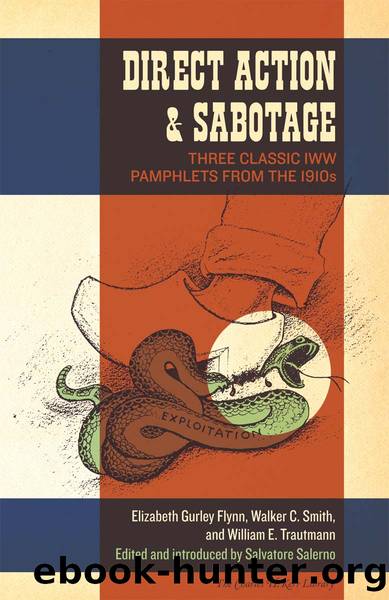
Author:Elizabeth Gurley Flynn
Language: eng
Format: epub
Publisher: PM Press
Published: 2014-08-14T16:00:00+00:00
Cartoon by Ralph Chaplin for the IWW’s Agricultural Workers’ Organization (1916)
Silent Agitator Sticker by Ralph Chaplin (circa 1916)
Sabotage
The Conscious Withdrawal of the Workers’ Industrial Efficiency
Elizabeth Gurley Flynn
Sabotage
THE INTEREST IN SABOTAGE IN THE UNITED STATES HAS DEveloped lately on account of the case of Frederic Sumner Boyd in the state of New Jersey, as an aftermath of the Paterson strike. Before his arrest and conviction for advocating sabotage, little or nothing was known of this particular form of labor tactic in the United States. Now there has developed a two-fold necessity to advocate it: not only to explain what it means to the worker in his fight for better conditions, but also to justify our fellow-worker Boyd in everything that he said. So I am desirous primarily to explain sabotage, to explain it in this two-fold significance, first as to its utility and second as to its legality.
Its Necessity in the Class War.
I am not going to attempt to justify sabotage on any moral ground. If the workers consider that sabotage is necessary, that in itself makes sabotage moral. Its necessity is its excuse for existence. And for us to discuss the morality of sabotage would be as absurd as to discuss the morality of the strike or the morality of the class struggle itself. In order to understand sabotage or to accept it at all it is necessary to accept the concept of the class struggle. If you believe that between the workers on the one side and their employers on the other there is peace, there is harmony such as exists between brothers, and that consequently whatever strikes and lockouts occur are simply family squabbles; if you believe that a point can be reached whereby the employer can get enough and the worker can get enough, a point of amicable adjustment of industrial warfare and economic distribution, then there is no justification and no explanation of sabotage intelligible to you. Sabotage is one weapon in the arsenal of labor to fight its side of the class struggle. Labor realizes, as it becomes more intelligent, that it must have power in order to accomplish anything; that neither appeals for sympathy nor abstract rights will make for better conditions. For instance, take an industrial establishment such as a silk mill where men and women and little children work ten hours a day for an average wage of between six and seven dollars a week. Could any one of them, or a committee representing the whole, hope to induce the employer to give better conditions by appealing to his sympathy, by telling him of the misery, the hardship and the poverty of their lives; or could they do it by appealing to his sense of justice? Suppose that an individual working man or woman went to an employer and said: “I make, in my capacity as wage worker in this factory, so many dollars worth of wealth every day and justice demands that you give me at least half.” The employer would probably have him removed to the nearest lunatic asylum.
Download
This site does not store any files on its server. We only index and link to content provided by other sites. Please contact the content providers to delete copyright contents if any and email us, we'll remove relevant links or contents immediately.
Time Management Made Easy: How to Cultivate New Habits, Improve Productivity and Get Things Done by Joshua Strachan(2417)
The 7 Habits of Highly Effective People by Stephen R. Covey & Sean Covey(2267)
The Concise Laws of Human Nature by Robert Greene(1914)
Doesn't Hurt to Ask by Trey Gowdy(1638)
Primal Leadership by Daniel Goleman(1283)
Hook Point: How to Stand Out in a 3-Second World by Brendan Kane(1246)
Don't Sweat the Small Stuff...and It's All Small Stuff by Richard Carlson(1121)
HBR's 10 Must Reads 2021 by unknow(1096)
The Power of 100! by Shaun King(1096)
Amazon Unbound by Brad Stone(1045)
100 Things Successful People Do by Nigel Cumberland(1030)
Master of One by Jordan Raynor(1008)
HBR's 10 Must Reads 2021 by Harvard Business Review(1007)
The Job Closer by Steve Dalton(993)
Lives of the Stoics by Ryan Holiday & Stephen Hanselman(969)
Declutter Your Mind: A step by step guide to learn to control your thoughts, stop worrying, relieve anxiety and eliminate panic attacks and negative thinking by Mia Chandler(968)
Conflicted by Ian Leslie(872)
The Book of Hope by Jane Goodall(872)
Coders at Work: Reflections on the craft of programming by Peter Seibel(847)
